ウルトラセブン
Ultra Monsters
Bemular-Reptillian space monster
Baltan-Humanoid alien arthropod
Neronga-Invisible electricity eating monster (Baragon from Toho with a new head
Ragon-Giant aquatic humanoid (Directly reused from Ultra Q)
Greenmons-Radioactive plant monster
Gesura-Toxic reptillian sea monster (Peter from Ultra Q with spines)
Antlar-Giant ant lion
Red King-Giant reptillian monster
Chandlar-Bat like flying monster (Pegila from Ultra Q with altered head)
Magura-Burrowing spiky creature
[[Pigmon-Small spiny,and freindly monster (Garamon from Ultra Q resued)
Suflan-Carnivorous plants
Gabora-Uranium eating monster with head shield
Jirass-Giant frilled dinosaur (Godzilla with a frill)
Gango-Giant cartoonish monster
Gomora-Giant Dinosuar like monster
Seabose-Freindly but cowardly ghost dinosaur
Zetton-Evil cyborg alien
ต่างดาว U-Tom
ต่างดาว U-Tom อุลตร้าเซเว่น

First Appearance: Episode 17, Underground Go! Go! Go! (January 28, 1968)
TNT Title: Cave In!
Height: 2.8 meters/Weight: 2 tons
A mysterious race of robots who dwell in an ultra-modern underground city, of whom the Ultra Garrison accidentally stumbled upon, during a rescue operation with their burrowing vehicle, the Magmariser. The U-Toms' right arm is a strong beam gun, while their left arm is a hammer-like device. And speak in a fast-paced twitter. Each individual are marked with different insignias upon their chest area (Tsuburaya Productions' attempt to create the illusion that there were many U-Toms, using only the one suit).
Although the exact origin and purpose of the U-Tom is never revealed, they prove to be hostile against the intruding humans. And thus the Ultra Garrison plant explosives to cause a cave-in, and forever entombed both the robots and their amazing city.
The U-Toms' character subtitle is Underground Robot, and an alternative version of their name is Yuhtom.
ต่างดาวคิวราโซ
ต่างดาวคิวราโซ Alien Quraso
First Appearance: Episode 7, Alien Prisoner 303 (November 12, 1967)
Height: 2.5-to-43 meters / Weight: 250 kg-to-10,000 tons
■Life Drain: Alien Quraso can drain the life out of whatever his hands grab.
■ Gasoline Consumption: Alien Quraso can consume large quantities of gasoline without any negative side effects.
■ Knock Out Shock: From the crest on his head, Alien Quraso can release an invisible shock that can knock out a human instantly. This shock can also be used for mind control.
■ Flames: Alien Quraso can spew flames from his mouth.
■ Growth: Alien Quraso can grow from human size to around that of Ultraseven's.
ต่างดาว คิงโจ
คิงโจ King Joe
His height is around 55 Meters tall.
He weighs around 48,000 Tons.
http://hicbc.com/tv/max/contents/kaiju/20051001/20051001_1.htm http://www.daikaijyu.com/galaxy1/monster/mons_kingjo.html http://www.daikaijyu.com/galaxy/monster/kingjhoe.html
His height is around 55 Meters tall.
He weighs around 48,000 Tons.
http://hicbc.com/tv/max/contents/kaiju/20051001/20051001_1.htm http://www.daikaijyu.com/galaxy1/monster/mons_kingjo.html http://www.daikaijyu.com/galaxy/monster/kingjhoe.html
ต่างดาวจิบูล
ต่างดาวจิบูล Alien Chibull
First Appearance: Episode 9, The Android Zero Directive (November 26, 1967)
TNT Title: Toys In Crisis
Height: 2 meters / Weight: 500 kg
■Human Disguise: Alien Chibull can disguise himself as a human.
■Badges: Alien Chibull has strange badges that can make simple objects like toys have some life of their own and even make them dangerous weapons. When Android Zero Directive was carried out the carriers of these objects would be subject to Alien Chibull's mind control.
■Android Zero: Alien Chibull can use the Android Zero for infiltration purposes. This android is armed with with a strong electric shock from the palms and fingers and can jam communication devices.
■Levitation: Alien Chibull can levitate to move.
First Appearance: Episode 9, The Android Zero Directive (November 26, 1967)
TNT Title: Toys In Crisis
Height: 2 meters / Weight: 500 kg
■Human Disguise: Alien Chibull can disguise himself as a human.
■Badges: Alien Chibull has strange badges that can make simple objects like toys have some life of their own and even make them dangerous weapons. When Android Zero Directive was carried out the carriers of these objects would be subject to Alien Chibull's mind control.
■Android Zero: Alien Chibull can use the Android Zero for infiltration purposes. This android is armed with with a strong electric shock from the palms and fingers and can jam communication devices.
■Levitation: Alien Chibull can levitate to move.
นักเขียนบทของอุลตร้าแมน

เท็ตสึโอะ คินโจ
< 1938 July 05-1976 Feb 26 >
<นะฮะ โอะกินะ>
The first creator of the Ultraman-series<อุลตร้าแมนซีรีส์>
He has known as the first-creator of Ultraman-story. After he graduated from the department of Education, the Literature of Tamagawa University in Tokyo, he came under his teacher"Teruo Uehara"'s influence in his student days. And he had interested in a scriptwriter. ....and After he went home in Okinawa, he began to write and produced the stage-play"Yoshiya-chiru guwaa monogatari ดราม่าของภาษาโอกินา>".
His teacher"Teruo Uehara" invited"Eiji Tsuburata<เอจิ สึบุระยะ:ผู้กำกับภาพยนตร์เทคนิคพิเศษ>"through his pupil"Noboru Tsumuraya[Son of Eiji Tsuburata<1935-1995>"]. and Tetsuo-Kinjo had been received a guidance of a scriptwriter from Shinichi Sekizawa<1920-1992: co.="" ltd.="" of="" screenwriter="" the="" toho="">. 1920-1992:>1935-1995>
1963, Tetsuo Kinjo entered the Tsuburaya Productions<สึบุระยะพรอดักชันส์> as a scriptwriter.
He had handled a scenario
These concepts was originated from the inspiration<1945-1972: age="" u.s.rule=""> in Islands of Okinawa by the key creator Tetsuo Kinjo. 1945-1972:>
Usually, most scriptwriters does not visit to the film studio. But he often visited the studio. And supplied AWAMORI<สุราอะวะโมะริ>-which bring from Okinawa- to stuffs in the Tsuburaya Productions<สึบุระยะพรอดักชันส์>.
Shinichi Sekizawa
Toho Co., Ltd.
สึบุระยะพรอดักชันส์
1966.Jan 02 completed"Ultra Q<อุลตร้า คิว>"
1966. Jul.17 complete"Ultraman<อุลตร้าแมน>"
1967. Oct.01 complete"Ultra Seven<อุลตร้าเซเว่น>"
เพลงอัลตร้าเซเว่น http://www.youtube.com/embed/I6wRNkf8mE0?rel=0

"King Joe".......His father(Kinjo) was called"King Joe".
In the Tsuburaya Productions<สึบุระยะพรอดักชันส์>, sometime neighboring children had visited to the film studio.
Next video is the video few in number of Tetsuo Kinjo 1.32minute only of total 9.03minute. You can look at the scene that Tetsuo-Kinjo interviewed children about Monsters.
As a result, some sponsors said that these programs'TV-program rating(%) are lower than Ultraman.
Since then, Orders from sponsors
The Tsuburaya Productions<สึบุระยะพรอดักชันส์> was facing to a deterioration of management by stopping an order from companies.
For that reason, the Tsuburaya Productions<สึบุระยะพรอดักชันส์> implemented a substantial restructuring of stuffs.
The literary section -which Tetsuo Kinjo belonging to- also was abolished. As a result, Tetsuo Kinjo lost an influential voice about a project. And then, He withdrawed by himself from the company on 1969
SF-TV series"Mighty Jack"
SF-TV series"Kaiki S.R.I." http://de.wikipedia.org/wiki/S.R.I._und_die_unheimlichen_F%C3%A4lle
The year of 1969 was under the sway of U.S.Military yet. So, When going to Tokyo, everyone had gone with a passport.
Tetsuo Kinjo.......Later on went home in Okinawa, he was active in to write and produce the Okinawan stage-play in Naha city.
He had played an active as a radio personality in the radio-station Okinawa.
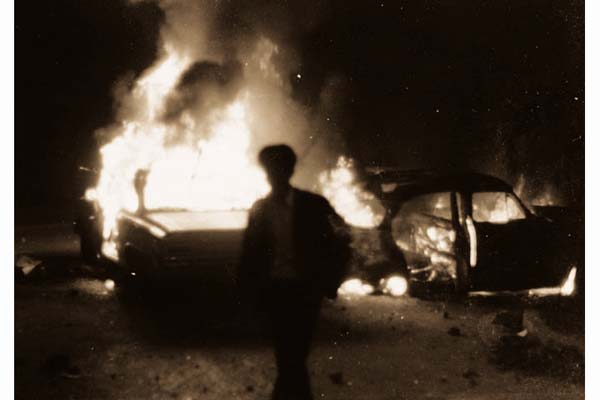
In those days, 1969, the incidents and accidents by U.S.soldier had occured often in Okinawa. An anti‐American feeling had increased day by day. A decision of 'not guilty' by U.S.military court against a hit‐and‐run drunken-driver blew up a dissatisfaction of Okinawan peoples.
As a result, one incident was occured at last on May 15, 1972. and its incident expand to a riot.
Koza riot
http://en.wikipedia.org/wiki/Koza_riot
http://www.youtube.com/embed/9df-Z2RW75I?rel=0
The year of a return to Japan is"1972. May 15".
Tetsuo Kinjo had interested the problem of Okinawa under the sway of U.S.Military. In those days, the world was the era of the Cold-War<สงครามเย็น>. Many peoples believed that U.S.military withdraws from Okinawa soon
http://en.wikipedia.org/wiki/Expo_%2775
After returning to Japan 1975, Tetsuo Kinjo also became a member about a direction and a planning of an entertainment"Okinawa Expo '75". He always had thought the future of Okinawa and engaged in the developing plan of Okinawa. But the situation of economy became worse and worse than before.
He appealed to public opinion on the local radio-program about its necessity of autonomous-defense with the Self-Defense Forces<กองกำลังป้องกันตนเอง> not depending on U.S.military. But his appeal was be unfavorably received by local-peoples.
From then, he had been worried between its necessity of autonomous-defense and what U.S.military should be.
And he had often gone get a drink.
One day midnight, he came home with a state of drunkenness. But he lost an office-key. and then, he tried to enter the 2nd-floor room from the window through the roof of house. He tried to move from the stairs to the roof. But lost his footing and fell with slipping.
He was transported to the hospital. But after 3 days, ........February 26, 1976........
He breathed his last in spite of treatment for a cerebral contusion .....aged 37years old.
Still today, his workroom has remained at Haebaru-town near Naha city as the record office.
The main building next to his workroom is a restaurant.
His work & Restaurant Restaurant"Syofuen"
http://www.syofuen.jp/annai.html
The main building next to his workroom is a restaurant.
His work & Restaurant Restaurant"Syofuen"
http://www.syofuen.jp/annai.html
โอะกินะ
การกลับมาของอุลตร้าแมน
การกลับมาของอุลตร้าแมน (แจ็ค)
超人力霸王傑克
O Regresso de Ultraman
monster The Return of Ultraman
< ข้อมูลจำเพาะ >
ความสูง : 40 เมตร
น้ำหนัก : 35,000 ตัน
อายุ : 17,000 ปี
ความเร็วในการบิน : 5 มัค
พลังกระโดด : 400 เมตร
ดาวบ้านเกิด: ดาวอุลตร้า นครแห่งแสง เนบิวล่า M78
อาวุธ&ท่าไม้ตาย : ลำแสงสเปเซี่ยม,อุลตร้าเบรชเล็ท,อุลตร้าสปาร์ค,อุลตร้าครอส,ซีเนราม่าช๊อต,อุลตร้าฟ็อกบีม
การป้องกัน : อุลตร้าแบริเออร์
มาโลกครั้งแรก : ค.ศ 1971
การแปลงร่าง : โดยการรวบรวมพลังจิตแล้วชูมือขึ้น
ร่างมนุษย์ : ฮิเดกิ โก สมาชิกหน่วย MAT
The Return of Ultraman (Kaettekita Urutoraman) is a tokusatsu SF/kaiju/superhero TV series, and is the 4th Ultra Series.
Eiji Tsuburaya had originally intended for the Ultra Series to end with the 1967 series Ultraseven (Urutora Sebun, 1967), but Ultraman (Urutoraman, 1966) proved to be too popular a character to keep down. After Eiji Tsubaraya's death in 1970, his son Hajime Tsuburaya (who took over Tsuburaya Productions until his own death in 1973) revived the Ultra Series with Return of Ultraman.
Featured in this show is a new Ultraman named "New Ultraman" (Shin Urutoraman), or just "Kaettekita Ultraman", like the show's title. In 1984, however, he was renamed "Ultraman Jack" (Urutoraman Jakku) due to licensing issues, after Tsuburaya and Bandai (which had just bought the Ultraman toy license in Japan) held a contest for children to pick a new name for this Ultraman.
Although he is called "Ultraman Jack" for licensing in and out of Japan, he is still sometimes referred to as "New Ultraman"/"Kaettekita Ultraman," by some fans (and also in some official sources). This change was done due to a last minute decision as the original plan for this series was for the original Ultraman to return to Earth to resume the fight against aliens and monsters.
While nearly identical in appearance to the original Ultraman, the red pattern on his silver suit is slightly different, and he can be distinguished by his shorter "pants," fuller "sleeves" and "kneepads," and pinstripes along the red areas.
Also of note is that Ultraman Jack is one of the few Ultra-Crusaders who requires no device (like the "beta capsule") to transform. Hideki Gô, the human host for New Ultraman, simply raises his hands to transform at will when New Ultraman signals him to do so--or, sometimes, against his will in a very desperate situation. Also there are times when Hideki Gô tries to transform only to have the process blocked due to New Ultraman refusing to transform under the circumstances.
For the first time, Ishirō Honda, best known for his work on the Godzilla movies and other classic Toho tokusatsu, worked on the Ultra Series, and directed some of the episodes of this series, including the first episode (titled "All Monsters Attack" (Kaijū Sōshingeki), which is the same as the Japanese title for the film All Monsters Attack).
This series is a follow up to the original Ultraman and Ultraseven. The first episode begins with a fight between two giant monsters Takkong and Zazahn in Tokyo. Amid the monster destruction, young race-car driver Hideki Go is killed while trying to rescue a little boy and a dog from the falling rubble. His valiant sacrifice is noted by everyone, even his friends and the new defense force MAT (Monster Attack Team), but an unseen being also takes notice. Looking over him is "New Ultraman (Ultraman Jack)," who is so touched by his heroics that he decides to combining his own life-force with Hideki's, thus bringing him back to life (just like the original Ultraman did with Shin Hayata), much to everyone's astonishment. MAT asks him to join the team, which he does, especially since, in this frightening new "Age of Monsters," Earth will need a savior.
In times of crisis, Hideki Go will raise his right arm and, by force of will, transform into Ultraman Jack to fight monsters.
Ultraman Jack is also the first Ultra-Crusader to suffer many types of humiliation, from having his Color Timer ("warning light") torn off to being decapitated.
Specium Ray: Jack can fire the Specium Ray by crossing his arms in a lower case "t" shape. It is exactly like the original Ultraman's Specium Ray. It can obliterate monsters in one shot.
Ultra Slash: Jack can fire the Ultra-Slash from his hand. Same as Ultraman's and Zoffy's. Can slice through monsters easily.
Ultra Bracelet: A multipurpose weapon that can be used like the Eye Slugger, but can also transform into a lance, a cross, shield, and light reflector. It can even piece back together a dismembered Ultraman.
Cinerama Shot: L-styled beam fired from his right arm.
Fog Beam: Jack can fire a stream of energy from his hand when he places his other hand above it. Similar to Ultraman's Slash Ray.
Eye Beams: Jack can fire powerful energy beams from his eyes.
Ultra Barrier: A telekinetic barrier that is powerful enough to turn back a tidal wave. Possibly one of the most elaborate display of movements for any Ultra ability.
Ultra-Frost: Jack can fire an ice beam attack that can defrost any freeze monsters.
Body Spark: Jack can send electric shock waves though his body. Used to shock monsters who are grabbing hold of Jack.
Palm Fireball: Jack can send out a fireball from his palm.
Finger Shot: Godai can smoke a strong crusher from his finger in a dragon rice as the Codenic Crusher, but counter than usual Codenic crusher.
Kaiju 怪兽 Кайдзю Monster สัตว์ประหลาด 괴물 Canavar Szörny Skrímsli Munstro
Kaijū Монстр Hirviö Монстр Monstro Potwór Monstrum Uhyre
Monstre מפלצות וחיות אגדיות Anime أنمي อะนิเมะ 动画 動畫 ऐनिमे Аниме انیمه Ανιμέ אנימה Аниме अॅनिमे Անիմե 일본의 애니메이션 Kaijū est un terme japonais pour désigner des créatures étranges, particulièrement des monstres géants des films japonais appelés kaijū eiga. La notion japonaise de monstre est différente de celle des Occidentaux, un kaijū est plutôt vu comme une force de la nature devant laquelle l'homme est impuissant et non pas une force du mal. Le kaijū eiga est un genre de film japonais qui emploie des maquettes de villes en carton et des acteurs costumés en grands monstres de latex. Les premiers kaijū eiga furent réalisés dans les années 1950, dans le contexte d'un Japon post-Hiroshima – ces premiers films mettaient souvent en scène le pouvoir de destruction de masse figuré par des kaijū qui détruisaient les cités –, et certains films de ce genre sont encore réalisés de nos jours. La plus connue de ces créatures cinématographiques est Godzilla, mais Gamera, Mothra, Rodan, Guidorah, Ebirah, Yonggary et même King Kong sont d'autres kaijū célèbres. Ishirō Honda, auteur des premiers Godzilla, fut un des plus prolifiques et célèbres réalisateurs de kaijū eiga.
超人力霸王傑克
O Regresso de Ultraman
monster The Return of Ultraman
< ข้อมูลจำเพาะ >
ความสูง : 40 เมตร
น้ำหนัก : 35,000 ตัน
อายุ : 17,000 ปี
ความเร็วในการบิน : 5 มัค
พลังกระโดด : 400 เมตร
ดาวบ้านเกิด: ดาวอุลตร้า นครแห่งแสง เนบิวล่า M78
อาวุธ&ท่าไม้ตาย : ลำแสงสเปเซี่ยม,อุลตร้าเบรชเล็ท,อุลตร้าสปาร์ค,อุลตร้าครอส,ซีเนราม่าช๊อต,อุลตร้าฟ็อกบีม
การป้องกัน : อุลตร้าแบริเออร์
มาโลกครั้งแรก : ค.ศ 1971
การแปลงร่าง : โดยการรวบรวมพลังจิตแล้วชูมือขึ้น
ร่างมนุษย์ : ฮิเดกิ โก สมาชิกหน่วย MAT
The Return of Ultraman (Kaettekita Urutoraman) is a tokusatsu SF/kaiju/superhero TV series, and is the 4th Ultra Series.
Eiji Tsuburaya had originally intended for the Ultra Series to end with the 1967 series Ultraseven (Urutora Sebun, 1967), but Ultraman (Urutoraman, 1966) proved to be too popular a character to keep down. After Eiji Tsubaraya's death in 1970, his son Hajime Tsuburaya (who took over Tsuburaya Productions until his own death in 1973) revived the Ultra Series with Return of Ultraman.
Featured in this show is a new Ultraman named "New Ultraman" (Shin Urutoraman), or just "Kaettekita Ultraman", like the show's title. In 1984, however, he was renamed "Ultraman Jack" (Urutoraman Jakku) due to licensing issues, after Tsuburaya and Bandai (which had just bought the Ultraman toy license in Japan) held a contest for children to pick a new name for this Ultraman.
Although he is called "Ultraman Jack" for licensing in and out of Japan, he is still sometimes referred to as "New Ultraman"/"Kaettekita Ultraman," by some fans (and also in some official sources). This change was done due to a last minute decision as the original plan for this series was for the original Ultraman to return to Earth to resume the fight against aliens and monsters.
While nearly identical in appearance to the original Ultraman, the red pattern on his silver suit is slightly different, and he can be distinguished by his shorter "pants," fuller "sleeves" and "kneepads," and pinstripes along the red areas.
Also of note is that Ultraman Jack is one of the few Ultra-Crusaders who requires no device (like the "beta capsule") to transform. Hideki Gô, the human host for New Ultraman, simply raises his hands to transform at will when New Ultraman signals him to do so--or, sometimes, against his will in a very desperate situation. Also there are times when Hideki Gô tries to transform only to have the process blocked due to New Ultraman refusing to transform under the circumstances.
For the first time, Ishirō Honda, best known for his work on the Godzilla movies and other classic Toho tokusatsu, worked on the Ultra Series, and directed some of the episodes of this series, including the first episode (titled "All Monsters Attack" (Kaijū Sōshingeki), which is the same as the Japanese title for the film All Monsters Attack).
This series is a follow up to the original Ultraman and Ultraseven. The first episode begins with a fight between two giant monsters Takkong and Zazahn in Tokyo. Amid the monster destruction, young race-car driver Hideki Go is killed while trying to rescue a little boy and a dog from the falling rubble. His valiant sacrifice is noted by everyone, even his friends and the new defense force MAT (Monster Attack Team), but an unseen being also takes notice. Looking over him is "New Ultraman (Ultraman Jack)," who is so touched by his heroics that he decides to combining his own life-force with Hideki's, thus bringing him back to life (just like the original Ultraman did with Shin Hayata), much to everyone's astonishment. MAT asks him to join the team, which he does, especially since, in this frightening new "Age of Monsters," Earth will need a savior.
In times of crisis, Hideki Go will raise his right arm and, by force of will, transform into Ultraman Jack to fight monsters.
Ultraman Jack is also the first Ultra-Crusader to suffer many types of humiliation, from having his Color Timer ("warning light") torn off to being decapitated.
Specium Ray: Jack can fire the Specium Ray by crossing his arms in a lower case "t" shape. It is exactly like the original Ultraman's Specium Ray. It can obliterate monsters in one shot.
Ultra Slash: Jack can fire the Ultra-Slash from his hand. Same as Ultraman's and Zoffy's. Can slice through monsters easily.
Ultra Bracelet: A multipurpose weapon that can be used like the Eye Slugger, but can also transform into a lance, a cross, shield, and light reflector. It can even piece back together a dismembered Ultraman.
Cinerama Shot: L-styled beam fired from his right arm.
Fog Beam: Jack can fire a stream of energy from his hand when he places his other hand above it. Similar to Ultraman's Slash Ray.
Eye Beams: Jack can fire powerful energy beams from his eyes.
Ultra Barrier: A telekinetic barrier that is powerful enough to turn back a tidal wave. Possibly one of the most elaborate display of movements for any Ultra ability.
Ultra-Frost: Jack can fire an ice beam attack that can defrost any freeze monsters.
Body Spark: Jack can send electric shock waves though his body. Used to shock monsters who are grabbing hold of Jack.
Palm Fireball: Jack can send out a fireball from his palm.
Finger Shot: Godai can smoke a strong crusher from his finger in a dragon rice as the Codenic Crusher, but counter than usual Codenic crusher.
Kaiju 怪兽 Кайдзю Monster สัตว์ประหลาด 괴물 Canavar Szörny Skrímsli Munstro
Kaijū Монстр Hirviö Монстр Monstro Potwór Monstrum Uhyre
Monstre מפלצות וחיות אגדיות Anime أنمي อะนิเมะ 动画 動畫 ऐनिमे Аниме انیمه Ανιμέ אנימה Аниме अॅनिमे Անիմե 일본의 애니메이션 Kaijū est un terme japonais pour désigner des créatures étranges, particulièrement des monstres géants des films japonais appelés kaijū eiga. La notion japonaise de monstre est différente de celle des Occidentaux, un kaijū est plutôt vu comme une force de la nature devant laquelle l'homme est impuissant et non pas une force du mal. Le kaijū eiga est un genre de film japonais qui emploie des maquettes de villes en carton et des acteurs costumés en grands monstres de latex. Les premiers kaijū eiga furent réalisés dans les années 1950, dans le contexte d'un Japon post-Hiroshima – ces premiers films mettaient souvent en scène le pouvoir de destruction de masse figuré par des kaijū qui détruisaient les cités –, et certains films de ce genre sont encore réalisés de nos jours. La plus connue de ces créatures cinématographiques est Godzilla, mais Gamera, Mothra, Rodan, Guidorah, Ebirah, Yonggary et même King Kong sont d'autres kaijū célèbres. Ishirō Honda, auteur des premiers Godzilla, fut un des plus prolifiques et célèbres réalisateurs de kaijū eiga.
Subscribe to:
Posts (Atom)